NFL
Philip Rivers’ NC State Homecoming Is Nearly Official—and It’s One Heck of a Gamble

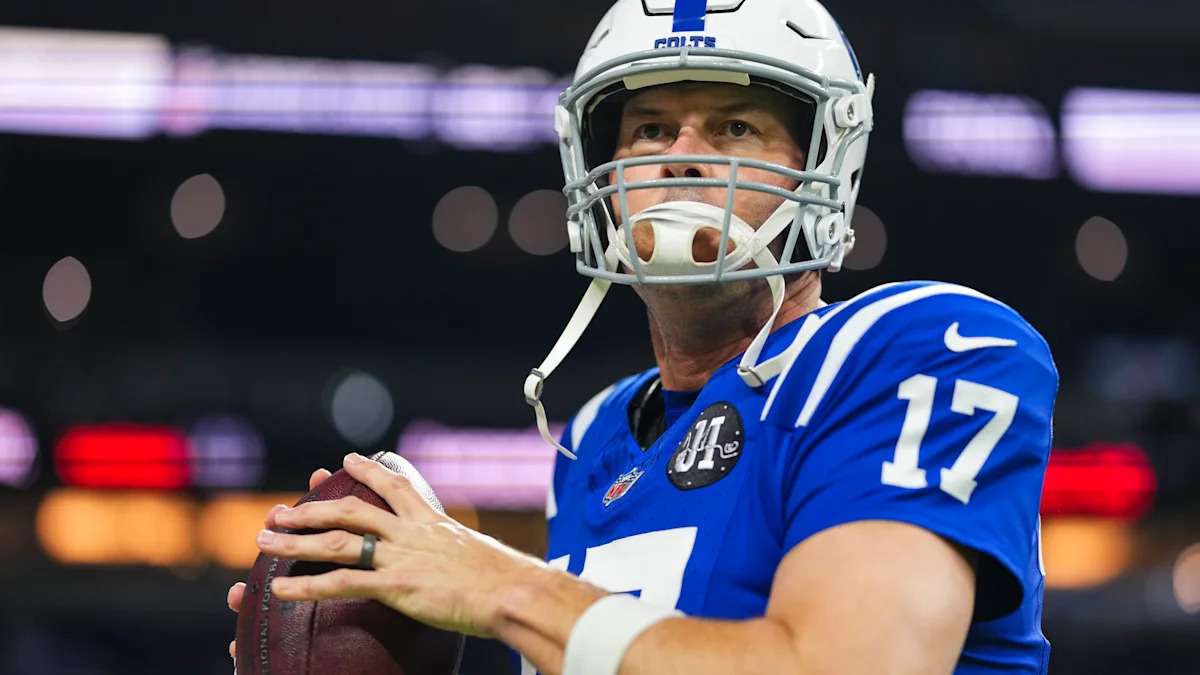
Philip Rivers is reportedly heading back to Raleigh, only this time he will not be wearing No. 17, taking shotgun snaps or trying to drag the Wolfpack through another Saturday afternoon thriller.
He is expected to become NC State’s next head football coach.
That sentence still looks strange on the page. Rivers has spent most of his football life as a quarterback, first becoming one of the greatest players in NC State history and then building a 17-year NFL career that made him one of the most recognizable players of his generation. Now, at 44, he is preparing to return to his alma mater in the most powerful football role the school can offer.
The hiring has not yet been formally announced by NC State. The university’s Board of Trustees is expected to finalize Rivers’ contract Friday, November 13, before the school makes the move official. Until that approval is complete, “reportedly” remains the responsible word.

But the direction of the program is clear: NC State is betting on a beloved former quarterback to lead the Wolfpack into a new era.
From Wolfpack legend to first-time college coach
Rivers’ connection to NC State is not a convenient footnote. It is the foundation of the entire decision.
He started 51 consecutive games for the Wolfpack from 2000 through 2003, throwing for 13,484 yards and 95 touchdowns. He won ACC Player of the Year as a senior, finished seventh in the Heisman Trophy voting and led NC State to four straight bowl appearances. His No. 17 jersey was retired before his final college game.
In other words, Rivers is not returning as a famous alumnus who happened to stop by campus on the way to somewhere else. He is one of the central figures in the school’s modern football history.
That history gives him immediate credibility with supporters, former players and recruits. It also gives him a level of emotional investment that a traditional outside hire might need years to develop. For NC State, which fired Dave Doeren after a 3-4 start, the appeal is obvious. Rivers knows what the program means to its fans because he helped define that meaning.
The less obvious part is whether knowing NC State is the same thing as knowing how to run it.
Rivers has no college coaching experience and has never been a head coach in the NFL. His coaching background comes from St. Michael Catholic High School in Fairhope, Alabama, where he has led the program since 2021. He built the Cardinals into a successful team, including state semifinal appearances in 2024 and 2025.
That is meaningful experience, but the jump from high school football to the ACC is enormous. College head coaches now have to manage recruiting, transfer-portal movement, NIL fundraising, staff construction, compliance, roster retention and the weekly pressure cooker of a major conference. The playbook is only one piece of the job. It may not even be the loudest piece anymore.
Rivers is walking into a job that looks less like coaching a football team and more like operating a small, heavily scrutinized corporation that happens to play on Saturdays.
The family connection makes the story even bigger
There is also a personal layer to the move that would make this homecoming feel almost too perfectly scripted if it were not happening in real time.
Rivers’ son, Gunner, is committed to play quarterback at NC State and is regarded as a four-star prospect in the 2027 recruiting class. Gunner has played for his father at St. Michael, creating the possibility of a father coaching his son in Raleigh as well.
That is a powerful recruiting story, but it also creates an immediate test. Rivers will have to establish that his program is bigger than his last name, even while the family connection becomes one of the most visible parts of the hire.
For NC State, the benefit is obvious: the Wolfpack are not merely hiring a coach. They are creating a storyline that recruits, fans and boosters can understand instantly. Philip Rivers is coming home, and his son may be part of the next chapter.
College football has always loved a good family angle. It just usually waits until the bowl game for the emotional music.
Why the gamble could work
Rivers’ strongest argument is not nostalgia. It is relevance.
He played quarterback at the highest levels, spent years diagnosing defenses and communicating with teammates, and recently coached a high school program from the sideline. He has also reportedly been involved in building out a potential staff and front-office structure, suggesting that NC State understands the importance of surrounding him with experienced college football operators.
That support system will be critical. Rivers does not need to pretend he has already mastered every corner of the modern college game. He needs to hire people who have, then provide the leadership, credibility and recruiting energy to make the operation function.
His personality should help. Rivers has always been intense, competitive and unapologetically football-minded. The same traits that made him such a compelling quarterback could translate well to recruiting and program-building, especially at a school where his personal history gives him instant access.
The question is whether that energy can become structure.
NC State has spent years hovering near respectability without breaking through into the ACC’s top tier. Doeren became the school’s winningest coach, but the Wolfpack never reached the ACC Championship Game or won more than nine games in a season under him. Rivers arrives with a chance to change that ceiling, but he also inherits expectations that will not be satisfied by a sentimental introduction and a few strong recruiting weekends.
The takeaway
This is both a homecoming and a gamble.
NC State is choosing a program icon over the conventional résumé, trusting that Rivers’ football intelligence, high school coaching experience and deep connection to the Wolfpack can outweigh his lack of college head-coaching experience. That is a bold decision, especially in a sport where the job now demands expertise in far more than X’s and O’s.
If the contract is approved Friday, Rivers will have the rare opportunity to coach the team he once carried as a player. He will also have to prove that being NC State’s quarterback legend is only the beginning of the job—not the qualification that ends the conversation.
The Wolfpack did not hire a safe choice. They hired a fascinating one.
And if Rivers can turn this emotional homecoming into a functioning college football operation, NC State may finally have the kind of identity it has been searching for.

The Pittsburgh Steelers have lost one of the quiet architects of their identity.
Dick Hoak, who spent 45 seasons with the organization as both a running back and assistant coach, died Wednesday, November 11, 2026. He was 86.
Hoak never chased the spotlight. He did something more difficult: He stayed. Through the franchise’s lean years, its transformation under Chuck Noll, the rise of the Steel Curtain, and the return to championship football under Bill Cowher, Hoak remained part of the Steelers’ daily machinery.
That kind of longevity is rare in the NFL. Doing it with one organization, in two completely different roles, is almost unheard of.
From Jeannette to the Steelers
Hoak was a western Pennsylvania football product in the truest sense. A native of Jeannette, he starred at Jeannette High School before continuing his career at Penn State. The Steelers selected him in the seventh round of the 1961 NFL Draft, and he spent his entire 10-year playing career in Pittsburgh.
As a halfback, Hoak appeared in 135 games and rushed for 3,965 yards and 33 touchdowns. He led the Steelers in rushing three times and remains among the most productive runners in franchise history.
Those numbers came during a difficult era for the organization. Hoak was not handed a ready-made dynasty. He played for the Steelers before the franchise became synonymous with Lombardi Trophies, black-and-gold dominance, and defensive players who seemed personally offended by the concept of forward progress.
He helped keep the operation moving before the glory arrived.
Hoak’s best rushing season came in 1968, when he produced a career-high 858 yards. He was selected to the Pro Bowl that year, a fitting recognition for a dependable player who brought toughness and consistency to an offense that often needed both.
When his playing career ended after the 1970 season, Hoak did not leave Pittsburgh. Two years later, Chuck Noll brought him onto the coaching staff as the team’s running backs coach.
That decision would shape the next 35 years of Steelers football.
The coach behind five championships
Hoak remained the running backs coach through the end of the 2006 season, working under both Noll and Cowher. He was part of five Super Bowl-winning teams and helped develop or guide some of the most important running backs in franchise history.
Franco Harris and Jerome Bettis became Pro Football Hall of Famers. Rocky Bleier became one of the most respected players of the Steelers’ championship era. Willie Parker became a defining piece of the team that won Super Bowl XL.
Hoak coached each of them.
That list says plenty about his football knowledge, but it does not fully explain his value. Running backs coaches are often judged by statistics, blocking assignments, ball security, and production. The best ones also understand personalities. They know when to correct, when to encourage, and when to let a player work through a problem without turning every mistake into a public event.
Hoak’s reputation was built on that steady influence. He was demanding without needing to perform toughness. He was respected without constantly reminding people of his authority. For generations of Steelers running backs, he was the coach waiting in the room, ready with a correction, a teaching point, or a reminder that details matter even when nobody outside the building notices them.
That approach fit the Steelers perfectly.
A legacy measured in trust
Steelers President Art Rooney II called Hoak a foundational figure for the organization, praising his toughness, loyalty, dedication, and commitment. Those words may sound familiar in a team remembrance, but in Hoak’s case, they describe the substance of his career rather than a convenient tribute.
He was not simply employed by the Steelers for 45 seasons. He became part of the franchise’s institutional memory.
Hoak was there when the team was trying to find its footing. He was there when Noll built the foundation of a dynasty. He was there when Harris and Bleier carried the offense through the 1970s. He was there when Bettis and Parker powered the 2005 championship team. The names changed. The era changed. Hoak stayed connected to the work.
In 2017, the Steelers recognized that contribution by making him part of the inaugural class of the team’s Hall of Honor. The class included many of the franchise’s most celebrated players and coaches, but Hoak’s inclusion carried a different meaning. He represented the people who build championship cultures without becoming the face of them.
In 2025, Hoak also received the Pro Football Hall of Fame’s Award of Excellence for assistant coaches, another acknowledgment of the often-overlooked work that happens behind the scenes.
There will always be Steelers whose legacies are captured by iconic plays, championship photographs, or bronze busts in Canton. Hoak’s legacy is captured differently: in the running backs he taught, the teams he helped shape, and the trust he earned from the organization over nearly half a century.
Dick Hoak gave the Steelers his entire professional life. He played for them, coached for them, and helped connect generations of players who otherwise might have seemed separated by time.
That is why his passing feels larger than the loss of a former player or assistant coach. Pittsburgh lost one of the people who helped make the Steelers feel like the Steelers.
His name belongs alongside the franchise’s most important figures—not because he demanded attention, but because he spent 45 years earning it.
The NFL had its Week 10 schedule set. The officials did not.
After the Federal Aviation Administration issued a nationwide ground stop Friday, the league rebuilt portions of its officiating assignments around a simple limitation: get the crews to their games without relying on air travel. That meant shifting officials to assignments within driving distance of home, elevating backup officials into referee roles and creating one of the strangest Sundays in modern NFL logistics.
Don Willard, normally a side judge, is scheduled to referee two games on Sunday, Nov. 15. He will work Dolphins-Colts at 1 p.m. ET in Indianapolis before making the roughly 110-mile drive to Cincinnati for Steelers-Bengals at 8:20 p.m. ET.
That is not a typo. The NFL has effectively given one official an afternoon assignment, a road trip and a prime-time game before most people have finished arguing about the early window.
A travel problem became an officiating problem
The FAA ground stop began Friday, Nov. 13, after communications issues affected multiple air traffic control centers. The disruption lasted for several hours and created a national backlog of delayed and canceled flights. Even after the ground stop was lifted, the impact continued into the weekend as airlines and travelers tried to untangle the mess.
NFL officials are not simply local employees who report to the nearest stadium. Crews travel across the country for assignments, generally arriving ahead of game day. When flights become unreliable on short notice, the league faces a problem that is less visible than a team missing a connection but just as important: the people responsible for enforcing the rules have to physically reach the field.
The NFL’s solution was practical rather than elegant. Officials were reassigned to games closer to their hometowns, where they could drive instead of fly. The league also relied on its built-in emergency structure, with backup referees stepping into the lead role.
Three backup officials are scheduled to work as referees Sunday. Duane Heydt will referee Panthers-Saints, Barry Anderson will handle Jaguars-Titans, and Willard will take charge of Dolphins-Colts before moving on to Cincinnati.
The backup system is getting a real test
Every NFL officiating crew has a designated backup referee who trains throughout the season to step into that position if necessary. That preparation is usually an insurance policy sitting quietly in the background. This weekend, it became the main plan for multiple games.
There is a reason the league does not simply grab any official and hand over the referee’s white hat. The referee is responsible for the crew’s overall operation, including pregame communication, penalty enforcement, replay procedures and the rhythm of the game. Moving an umpire or side judge into that role requires familiarity with the position and enough preparation to make the transition without turning every third down into a staff meeting.
The changes also show why the NFL treats officiating as a logistics operation as much as a rules operation. The league is not only assigning the best officials to the most important games. It has to assemble complete crews, account for travel, maintain proper coverage and make sure everyone can arrive safely and on time.
In that sense, the goal is not to preserve every original assignment. The goal is to preserve the games themselves.
Willard’s Sunday is unlike anything the NFL usually asks of an official
Willard’s schedule is the headline because of the sheer timing. Dolphins-Colts kicks off at 1 p.m. ET at Lucas Oil Stadium. Steelers-Bengals begins at 8:20 p.m. ET at Paycor Stadium, leaving more than seven hours between kickoffs.
The drive from Indianapolis to Cincinnati is roughly 110 miles, a trip that can be manageable under normal conditions. But “manageable” is doing a lot of work here. An NFL official does not simply walk out of one stadium, toss a jacket in the back seat and hope traffic cooperates. There are postgame responsibilities, security procedures, equipment considerations and the need to arrive with enough time to prepare for the second assignment.
The distance is short compared with the flights officials might normally take, but the day is still demanding. Willard will be asked to reset mentally, physically and procedurally between two different games, two different stadiums and two different crews.
It is also important to be precise about the historical claim. The arrangement appears to be unprecedented, and multiple reports have described it as a first-of-its-kind situation. However, the NFL has not publicly confirmed that Willard is definitively the first official in league history to work two regular-season games on the same day. That distinction matters, especially when the league’s own announcement focused on the assignment changes rather than declaring a record.
Either way, it is an extraordinary workload created by an extraordinary travel disruption.
Why the league made the changes
The NFL could have tried to preserve the original officiating crews and hope the travel system recovered. That would have created a much bigger risk. A delayed official is not like a delayed fan. If a crew cannot reach a stadium, the league has to find a replacement quickly, and last-minute improvisation is exactly what the backup system is designed to avoid.
Reassigning officials by driving distance gives the league more control. Road travel is not immune to delays, but it is more predictable than depending on airports still recovering from a national shutdown. It also reduces the chance that an official is stranded far from the assigned game or forced into a rushed connection.
Safety is the central issue. The league’s changes were not made for novelty or convenience. They were made because air travel conditions remained unstable, and the NFL needed its officiating crews in place before kickoff.
That is the useful takeaway from this bizarre football subplot: the games are staying on schedule because the league was willing to treat officiating like a moving puzzle. Backup officials were prepared. Assignments were reshuffled. One official may spend Sunday working two games and driving between them.
The NFL usually asks its officials to watch everything. On Nov. 15, the league may ask Don Willard to officiate nearly an entire day of football in two cities. A nationwide aviation failure has turned one Sunday into a roadshow, and the most important part is that the whistle should still be ready when the games begin.

The Steelers made the defensive-line decision they had been waiting on Saturday, activating Derrick Harmon from injured reserve and clearing a spot by waiving cornerback Terell Smith.
Harmon's return puts a potentially important piece back on Pittsburgh's 53-man roster just one day before the Steelers visit Cincinnati for an AFC North showdown. It does not guarantee he will be active Sunday night, but it gives him a chance to suit up in a matchup that already carries plenty of personal history.
The second-year defensive tackle returned to practice Wednesday after missing the previous four games with a foot injury. He was limited Wednesday and Thursday before becoming a full participant Friday. Harmon was listed as questionable entering the weekend, making Saturday's transaction the final major hurdle in his comeback.
A return with some history
Harmon already delivered one of Pittsburgh's biggest moments against Cincinnati this season. In the Steelers' 30-27 Week 3 victory, he sacked Joe Burrow late in the game, forcing a fumble that Sebastian Joseph-Day recovered. The play helped preserve Pittsburgh's win and gave Harmon an early signature moment in his second season.
A week later, Harmon suffered the foot injury that interrupted his promising start. He was placed on injured reserve and forced to watch the Steelers navigate the next month without him. Now, the timing of his return could hardly be more dramatic: Cincinnati is the opponent, the stakes are significant, and the defensive tackle has already shown he can affect this matchup.
That does not mean Pittsburgh should expect another strip-sack on demand. Football is not a vending machine, despite how often fans treat it like one. But Harmon's interior quickness gives the Steelers another way to challenge Burrow, particularly if he is healthy enough to handle a meaningful rotation.
Why the defensive line needs him
Pittsburgh's defensive front has held together while Harmon was sidelined, but the unit has had to distribute more work among Cameron Heyward, Keeanu Benton, Yahya Black and the younger players behind them. Sebastian Joseph-Day is also on injured reserve, making depth inside even more valuable.
Harmon brings a different type of disruption to that group. The Steelers announced that he had 12 tackles, one tackle for loss, one and a half sacks and a forced fumble in four games before his injury. Those numbers reflect a player who was not merely filling snaps. He was creating problems in the middle of the line and giving Pittsburgh another interior pass-rush option.
His return could allow the Steelers to be more flexible with their defensive-front rotations. Benton and Heyward would not necessarily have to carry quite as much responsibility, while Harmon could attack guards and centers who have spent the last several weeks preparing for a different group of interior defenders.

The most realistic expectation, however, is measured usage. Harmon has not played since the injury, and even a full practice on Friday cannot completely replicate game conditions. Pittsburgh may ease him in rather than immediately handing him a starter's workload. If he is active, his impact could come in a handful of high-leverage snaps instead of a massive snap count.
The roster move matters, too
To make room for Harmon, Pittsburgh waived Smith, a cornerback the team signed to its active roster in October. That move reflects the roster math that accompanies every injured-reserve return. Activating one player means another player has to go, and the Steelers chose to create space in the secondary for help along the defensive line.
Smith had provided depth at cornerback and appeared in Pittsburgh's recent defensive-back rotation, but the Steelers are also getting healthier at several spots in the secondary. Brandin Echols and Doneiko Slaughter both finished the week as full participants, while safety DeShon Elliott also practiced fully Friday. That gave Pittsburgh a little more flexibility when deciding which position could absorb the loss.
The transaction also shows how highly the Steelers value Harmon's potential contribution. A roster spot is not guaranteed simply because a player is eligible to return. Pittsburgh chose to make the move because the possibility of having Harmon available against Cincinnati outweighed the need to keep Smith on the 53-man roster.
Still, activation and availability are not identical. Harmon can be on the active roster and remain inactive on game day if the coaching staff decides he needs more time. His questionable designation remains relevant until the team submits its inactive list Sunday.
The takeaway
The Steelers did not activate Derrick Harmon because one roster move guarantees a defensive masterpiece. They activated him because the matchup, the injury timeline and the team's need for interior depth made the gamble worthwhile.
Harmon has already made a difference against Cincinnati once this season. Now Pittsburgh is giving him the opportunity to make another one. Whether that means a full return, a limited package or simply a spot among the inactives will not be known until kickoff. But after four games away, the Steelers' defensive line finally has its most intriguing missing piece back in the conversation.

 Featured2 years ago
March Tourney: Big Money ($3 Billion!)

 Sports Gambling News2 years ago
Micah Parsons Dreams of a $40 Million Contract: The Key to His Happiness!
- Featured2 years ago
New York Jets’ Hilarious Attempt to Land Mike Vrabel Ends in Patriots’ Embrace

 General Sports News2 years ago
The Biggest World Series Favorites Since the Legendary ’02 Yankees

 Sports Gambling News2 years ago
Scottie Scheffler: The Betting Favorite at The Player

 Sports Gambling News2 years ago
Marco Penge’s Epic Comeback: From Betting Ban to Euro Tour Glory!

 NFL1 year ago
Jordan Addison’s Suspension

 Pittsburgh Sports1 year ago
Penguins Hall of Fame New Inductees