General Sports News
Brewers Brew Up a Storm: Homers Propel Milwaukee to Near NLCS Glory
In a game that felt more like a home run derby than a playoff match, the Milwaukee Brewers took a commanding 2-0 lead in the NLDS against the Chicago Cubs, winning 7-3. Andrew Vaughn and Jackson Chourio each launched three-run homers, making history as the first duo to do so in Brewers postseason lore. Meanwhile,…


In a game that felt more like a home run derby than a playoff match, the Milwaukee Brewers took a commanding 2-0 lead in the NLDS against the Chicago Cubs, winning 7-3. Andrew Vaughn and Jackson Chourio each launched three-run homers, making history as the first duo to do so in Brewers postseason lore. Meanwhile, William Contreras added a solo shot, proving that the Brew Crew’s bats were hotter than a jalapeño in July. The Cubs, on the other hand, were left scratching their heads, with Seiya Suzuki’s impressive 440-foot three-run blast being the only highlight in a night filled with Brewers fireworks. As the series shifts to Wrigley Field, the Cubs will need to channel their inner Houdini to escape this 2-0 hole. Speaking of magic, did you catch the latest on the Mariners’ epic weekend? Check it out [here](https://www.foxsports.com/stories/mlb/these-fans-phenomenal-mariners-end-wild-sports-weekend-seattle-lifting-24-year-weight). And if you’re wondering about the odds for the upcoming games, you can find that [here](https://www.foxsports.com/stories/mlb/2025-mlb-divisional-round-odds).

College Football
Florida rallies past No. 11 Kentucky 21-14 as Aaron Philo spoils Jon Sumrall’s return to Lexington


Florida arrived in Lexington with plenty of questions and left with something far more valuable: bowl eligibility, a road win over a ranked SEC opponent and a reminder that this Gators team is capable of making life extremely uncomfortable for anyone who assumes it has already figured them out.
Florida defeated No. 11 Kentucky 21-14 on Saturday night at Kroger Field, overcoming a slow offensive start and a halftime deficit to take control in the second half. The win pushed the Gators to 6-4 overall and 4-4 in SEC play, while Kentucky fell to 7-3 and 5-3.
For Florida coach Jon Sumrall, the victory came in a place that has shaped nearly every stage of his football life. He played linebacker at Kentucky, suffered a career-ending injury there and later returned to Lexington as a coach. His first game back as Florida’s head coach was never going to feel like a routine conference road trip.
It also ended with Sumrall embracing the player who made the biggest difference.
Philo turns the game around
Aaron Philo returned to the starting lineup and delivered the kind of performance Florida desperately needed. The quarterback completed 16 of 24 passes for 119 yards and added 102 rushing yards on 15 carries, including the go-ahead touchdown with 9:08 remaining.
That combination made Philo the central figure in a game Florida won with toughness more than style points. The Gators finished with 211 rushing yards, controlled the ball for more than 34 minutes and repeatedly leaned on the ground game as the night wore on.
Kentucky opened the scoring with a first-quarter touchdown, but Florida’s defense kept the damage limited. The Gators managed only a safety before halftime, trailing 7-2 at the break, yet they never allowed the Wildcats to create the kind of separation that would have turned the game into a comfortable home win.
Florida finally found its offensive rhythm in the third quarter. Philo’s rushing ability gave the Gators a way to move the chains when the passing game was not producing much, and Florida used a two-point conversion to pull ahead 10-7. Kentucky answered with a touchdown to reclaim the lead, but the Wildcats’ advantage lasted only until Florida’s decisive fourth-quarter march.

The defining drive covered 67 yards over 14 plays. Philo finished it himself, taking a two-yard run into the end zone to put Florida ahead 15-14. The Gators added another two-point conversion, creating the 21-14 final and forcing Kentucky to chase the game late.
That is where Florida’s defense finished the job.
Kentucky had chances, but no answers
Kentucky moved the ball through the air, with quarterback Kenny Minchey throwing for 181 yards, and DJ Miller added 80 receiving yards. But the Wildcats struggled to run the football, finishing with only 61 rushing yards as a team.
That imbalance became more damaging as Florida settled in. Kentucky’s offense could not consistently stay on schedule, and the Wildcats were shut out in the fourth quarter despite playing with the lead for much of the night.
Florida also won the efficiency battle. The Gators converted 9 of 17 third downs, compared with Kentucky’s 5 of 10, and produced 19 first downs to the Wildcats’ 14. Those details explain why the game felt closer than Florida’s control of the second half suggested. Kentucky had enough production to stay within striking distance, but Florida was better at extending drives and turning possession into pressure.
The Wildcats’ final opportunity ended when Florida’s defense stopped a fourth-down attempt while protecting the seven-point lead. It was not a glamorous finish. It was the SEC version of closing a door, checking the lock and refusing to answer when someone knocks again.
What the upset means
For Florida, this was the kind of win that can change the tone of a season. The Gators are now bowl eligible with two regular-season games remaining, and Sumrall has a signature road victory at the program where he played and began his coaching career.
The result also provides a needed response after Florida’s recent offensive inconsistency. The Gators had struggled to sustain momentum in losses to Oklahoma and Georgia, and Philo had been benched against Georgia before reclaiming the starting job Saturday. His performance did not erase every concern, but it gave Florida a clear answer for this game: let Philo use his legs, trust the rushing attack and make the defense carry its share of the night.
Kentucky, meanwhile, saw its margin for error shrink dramatically. At 7-3, the Wildcats remain in the SEC race, but the loss badly damages their College Football Playoff hopes. A home defeat against a Florida team that entered with four losses is the sort of result that lingers through selection debates, especially when the rest of the conference keeps producing heavyweight matchups.
And for Sumrall, the emotional subplot landed exactly where it should have: in the background of a football result that mattered on its own. He did not return to Lexington simply for a sentimental reunion. He returned to win, and Florida did that by surviving Kentucky’s early punch, finding its quarterback late and finishing with the more dependable line of scrimmage.
The takeaway is simple. Florida may not be a finished product, but it is not an easy out either. On Saturday, the Gators turned a difficult return trip into one of the SEC’s most important upsets of the weekend.

Tiger Stadium had the noise, the lead and nearly every reason to believe Texas was leaving Baton Rouge with another painful chapter in its season. Then Arch Manning took the field with 2:19 remaining, and the Longhorns turned a night of mistakes into the kind of victory that changes a season.
No. 6 Texas rallied from a 21-16 deficit to defeat No. 21 LSU, 22-21, on Saturday night. Manning finished the game with three interceptions and only 174 passing yards, which makes the ending even more revealing: Texas did not win because its quarterback played a clean game. Texas won because, when the entire game narrowed to one possession, Manning made the throws and runs that mattered most.
The decisive moment came with three seconds left. Manning found Raleek Brown for a 4-yard touchdown pass near the left sideline, completing a 12-play, 58-yard drive that took 2:16. The winning possession included a sack, a replay reversal that kept Ryan Wingo from being charged with a fumble, two Manning runs for first downs and a final red-zone decision that demanded absolute trust.
For Texas, this was more than a dramatic road win. It was a quarterback moment, a statement about the Longhorns’ staying power in the SEC and a result that keeps their College Football Playoff hopes firmly alive.
A messy game became Manning’s stage
Manning’s night was uneven long before it became memorable. He threw two interceptions to LSU safety Ty Benefield in the first half, including one that helped set up LSU’s second touchdown. The Tigers turned that takeaway into a 9-yard touchdown pass from Sam Leavitt to Jackson Harris, building a 14-7 lead.
LSU also controlled the statistical picture. The Tigers finished with 366 total yards to Texas’ 273. Leavitt passed for 244 yards and two touchdowns, while Dilin Jones ran for 125 yards and a 44-yard score. That touchdown pushed LSU’s advantage to 21-10 with 5:52 left in the third quarter, and Texas looked like a team trying to survive rather than a team ready to seize the night.
But the Longhorns kept finding just enough offense and just enough defense. Gianni Spetic made field goals from 41 and 50 yards, trimming the deficit to 21-16. Texas’ defense then forced LSU into consecutive punts, creating the final opportunity Manning needed.
That distinction matters. This was not a one-man rescue act. Texas’ defense produced three takeaways and three sacks, and it held LSU without a point in the fourth quarter. The defense kept the door unlocked. Manning finally kicked it open.
The final drive was a test of nerve
Texas started at its own 42 after an LSU punt with 2:19 remaining. The opening play went to Brown, who gained two yards. Manning then hit Emmett Mosley V for five yards before connecting with Wingo for a first down at the LSU 46.
The drive immediately developed the sort of tension that makes late-game football feel less like strategy and more like a legal dispute with time itself. Manning was sacked for a six-yard loss with 1:11 left, putting Texas in a difficult second-and-16. One minute later, he found Wingo again for 13 yards.
On third-and-3 from the LSU 39, Manning kept the ball and ran for the first down. The play went to review, but the call stood. With 30 seconds left, he hit Wingo for 19 yards to the LSU 16, then found him again on the next play.
That second catch initially appeared to end with a fumble recovered by LSU. Replay overturned the ruling, however, determining that Wingo was down by contact. Instead of a crushing turnover, Texas had the ball at the LSU 11 with 19 seconds remaining.
Manning missed on a pass to Jermaine Bishop Jr., then ran for seven yards to the LSU 4. After a timeout, another pass to Bishop fell incomplete with eight seconds left. Texas had one timeout and two downs to work with.
Manning did not force the throw into the first available window. He waited, moved the defense and found Brown for the touchdown with three seconds remaining. The extra-point attempt was not made, but Texas had already done enough. The Longhorns had turned a 21-16 hole into a win without ever leading during the second half.
That is not a polished quarterback performance. It is something more valuable in November: a resilient one.
What the win means for Texas
Texas improved to 8-2 overall and 5-2 in SEC play, while LSU fell to 6-4 and 3-4. The Longhorns’ playoff outlook remains strong because this victory came on the road against a ranked SEC opponent, even if the game will not impress anyone searching for a flawless box score.
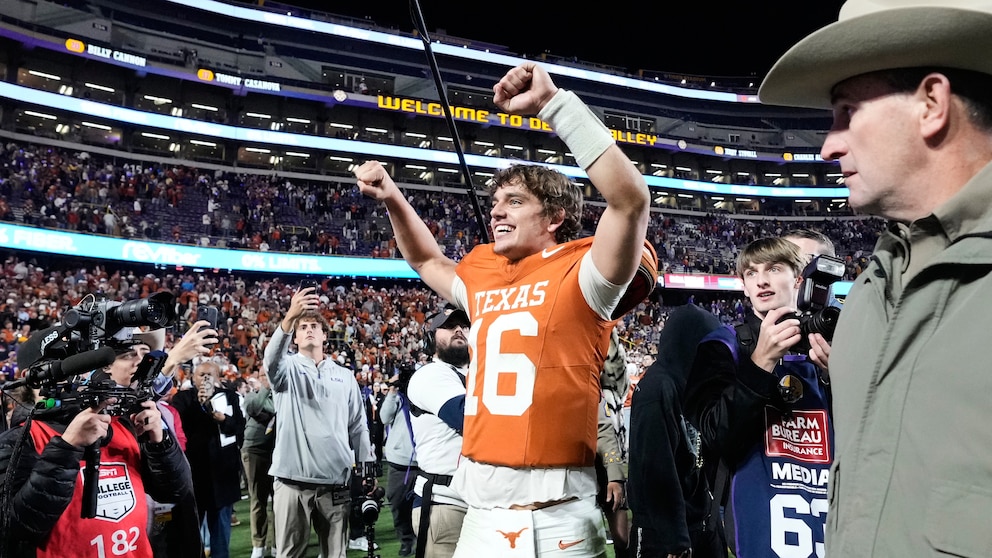
Manning’s numbers will invite criticism. Nineteen completions on 35 attempts, 174 yards and three interceptions is not the statistical profile of a dominant afternoon. Yet quarterback evaluation has never been only about the cleanest three-and-a-half quarters. The final possession showed pocket toughness, athleticism, composure and the willingness to keep making decisions after several earlier decisions had gone wrong.
It also gave Texas another piece of evidence about its ceiling. The Longhorns can win when the offense is inefficient. They can win when the opponent outruns them in total yardage. They can win in a hostile stadium when the game demands a quarterback take responsibility for the final possession.
For LSU, the loss was brutal because the Tigers did enough to win for most of the night. They led 21-10, outgained Texas by 93 yards and had Manning under pressure repeatedly. But LSU’s offense disappeared in the fourth quarter, and the Tigers handed Texas one final possession after another punt. A missed 38-yard field goal before halftime also looms large in a game decided by one point.
Texas hosts Arkansas next Saturday. The Longhorns will have to clean up the interceptions and improve their offensive efficiency if they want to make a serious playoff run. But the most important takeaway from Baton Rouge is simpler: when the season demanded a signature drive, Arch Manning produced one.
The performance was messy. The ending was not.
College Football
Utah survives Arizona 40-39 after Devon Dampier engineers another late escape in Tucson
No. 2 Utah walked into Tucson unbeaten, walked out unbeaten and somehow made the final few minutes feel like a personal attack on everyone wearing red.
The Utes survived No. 23 Arizona 40-39 on Saturday night, November 14, 2026, in a wild Big 12 battle that featured a massive comeback, a late Utah touchdown drive and one final Arizona mistake that ended the Wildcats’ last chance to steal the game. Utah improved to 10-0 overall and 7-0 in conference play, while Arizona fell to 7-3 and 4-3.
This was not a comfortable road win. It was the kind of game that leaves a coaching staff reaching for antacids and a fan base checking the scoreboard every six seconds.
Arizona kept turning pressure into points
The Wildcats made Utah work for every inch from the opening kickoff. Arizona quarterback Noah Fifita delivered one of his best performances of the season, throwing for 356 yards and repeatedly finding Chris Hunter, who finished with 119 receiving yards.
Arizona did not simply hang around. The Wildcats pushed Utah into a genuine fourth-quarter emergency.
The Utes entered the closing stretch trailing 39-34, and the game had begun to tilt toward the home team. Arizona’s offense was moving the ball, the crowd was fully engaged and Utah’s defense had surrendered far more than it usually allows. The Utes finished the game giving up 415 total yards, including 356 through the air.
But Utah’s offense answered when the game demanded it.
Devon Dampier finished with 204 passing yards and two touchdowns, but the numbers do not fully explain his impact. The Utah quarterback delivered the decisive late drive, including a 60-yard completion that flipped the field and gave the Utes the kind of opportunity they needed.
A few plays later, Utah found the end zone on a touchdown pass to Byrd Ficklin. The score put the Utes ahead 40-39 and turned the final minutes into a test of nerve, communication and basic football survival.
Utah passed that test by the narrowest possible margin.
The final Arizona possession unraveled
Arizona still had one more opportunity after Utah took the lead. That is what made the finish so tense. The Wildcats were not chasing a two-score deficit or needing a miracle from midfield. They had a chance to move the ball, get into scoring range and reclaim the game.
Instead, a snap-related mistake prevented Arizona from getting off one last meaningful play.
That error became the defining image of a game in which the Wildcats had done plenty right. Arizona moved the ball more efficiently through the air, controlled possession for nearly 34 minutes and repeatedly answered Utah’s scoring bursts. But in a one-point game, the smallest breakdown becomes the entire story.
Utah did not dominate the stat sheet in the traditional sense. Arizona had 21 first downs to Utah’s 20 and ran 74 plays compared with Utah’s 60. The difference came on the ground, where the Utes produced 296 rushing yards while Arizona managed only 59.
Daniel Bray led Utah’s ground attack with 197 rushing yards, giving the Utes the physical edge they needed to stay alive when the passing game became more difficult. That balance mattered late. Utah could keep attacking with the run, force Arizona to respect the entire playbook and create the opening Dampier eventually found.
The Utes also avoided the kind of turnover that could have ended the game early. Arizona’s final snap mistake was devastating, but Utah deserves credit for putting the Wildcats in a situation where every remaining second mattered.
What the win means for Utah
The victory keeps Utah perfect at 10-0 and preserves its position at the top of the Big 12 race. More importantly, it keeps the Utes firmly in the College Football Playoff conversation with only a few regular-season games remaining.
There is a difference between winning comfortably and winning under pressure. Utah has now shown it can handle both, although the coaching staff would probably prefer fewer games that require a late touchdown and a favorable bounce from the football gods.
The defense will have plenty to correct. Giving up 39 points and allowing Fifita to throw for 356 yards is not the formula Utah wants to carry into the postseason. The Utes were able to survive because the offense produced 500 total yards, the rushing attack overwhelmed Arizona’s front and Dampier made the critical plays when the game reached its most important moment.
That is the encouraging part. Championship contenders rarely go through an entire season without getting punched in the mouth. The important question is whether they can respond before the game gets away from them. Utah answered that question in Tucson.
For Arizona, the loss stings because the Wildcats were close enough to make it matter. They remain bowl eligible, but the defeat damages their position in the Big 12 race and removes some of the margin for error from the rest of the schedule. Arizona proved it can challenge one of the country’s best teams. It also proved that one late mistake can erase nearly four quarters of excellent work.
The takeaway is simple: Utah did not look unbeatable, but it looked resilient. The Utes survived a hostile road environment, absorbed Arizona’s best punches and found one more answer than the Wildcats did.
At this stage of the season, that may be more valuable than a comfortable win. Utah is still unbeaten, still alive for the Big 12 crown and still moving toward the playoff with a growing collection of close calls behind it. The Utes just need to stop making the journey so stressful for everyone watching.

 Featured2 years ago
March Tourney: Big Money ($3 Billion!)

 Sports Gambling News2 years ago
Micah Parsons Dreams of a $40 Million Contract: The Key to His Happiness!

 General Sports News2 years ago
The Biggest World Series Favorites Since the Legendary ’02 Yankees
- Featured2 years ago
New York Jets’ Hilarious Attempt to Land Mike Vrabel Ends in Patriots’ Embrace

 Sports Gambling News2 years ago
Scottie Scheffler: The Betting Favorite at The Player

 Sports Gambling News2 years ago
Marco Penge’s Epic Comeback: From Betting Ban to Euro Tour Glory!

 NFL1 year ago
Jordan Addison’s Suspension

 General Sports News1 year ago
Trevor Lawrence Stuns Patrick Mahomes in a Monday Night Showdown