College Football
Penn State’s receiver room just got a little less fun

Penn State’s offense has hit the first real pothole of the season, and it comes with all the mystery of a locked suitcase in a hostage movie. Wide receiver Koby Howard is out indefinitely with an undisclosed injury, leaving the Nittany Lions to open Big Ten play against Wisconsin without the team’s leading receiver and top pass-catching spark. Coach Matt Campbell said the injury is not season-ending, which is the kind of phrase that makes everyone feel slightly better and somehow even more nervous at the same time.
Howard’s setback came after he put together a breakout day against Buffalo, finishing with 135 yards of total offense and two scores, including a 70-yard catch-and-run touchdown that apparently required the football gods to collect their receipt. That’s the cruel little joke of college football: just when a young playmaker starts looking like he can turn any snap into a fireworks show, the depth chart starts looking like a kitchen drawer after a cross-country move. Penn State will survive because Penn State usually survives, but the timing is brutal. Big Ten play arrives on schedule, Wisconsin is not known for sending sympathy cards, and the Nittany Lions now have to prove their receiver room has more than one microwave that works.


Texas Tech’s offense has gone from intriguing to borderline unfair in the span of two Saturdays.
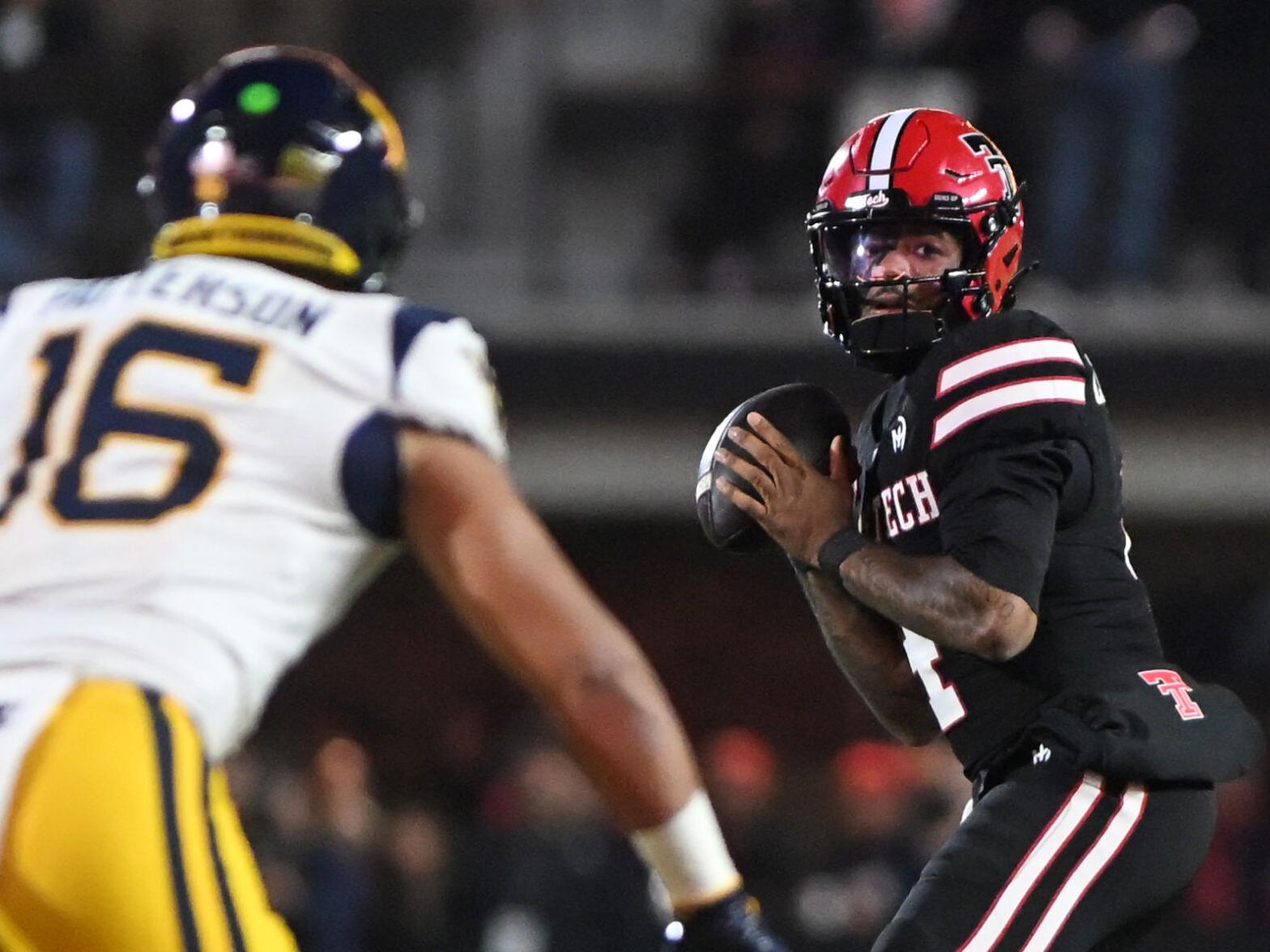
Thomas Castellanos needed only two games to produce 765 total yards and nine touchdowns, leading the Red Raiders through explosive wins over West Virginia and Oklahoma State. The numbers are eye-catching, but the bigger story is how quickly Castellanos has changed the shape of Texas Tech’s offense.
The Red Raiders are no longer simply trying to execute their system. With Castellanos at quarterback, they are forcing defenses to solve a problem with two answers: survive his arm or survive his legs. So far, opponents have not found a comfortable option.
The two-game eruption
Castellanos began the surge on November 7 against West Virginia, throwing for a career-high 362 yards and five touchdowns in Texas Tech’s 53-48 victory. He completed 18 of 27 passes without an interception and added 102 rushing yards.
That performance alone would qualify as a breakout. Castellanos became the first Texas Tech quarterback to throw for at least 350 yards and five touchdowns while also rushing for 100 yards in the same game. It was a ridiculous statistical line wrapped inside an even more ridiculous game, with the two teams combining for 101 points.
A week later, Castellanos followed it with another four-touchdown passing performance in a 52-27 road win at Oklahoma State. He threw for 263 yards and added 38 yards on the ground, giving him 625 passing yards, 140 rushing yards and nine passing touchdowns across the two-game stretch.
That adds up to 765 total yards. It also explains why national attention arrived so quickly. This was not a quarterback piling up empty production in a pair of shootouts. Castellanos helped Texas Tech win both games, and the second victory came on the road against a ranked Oklahoma State team that had been positioned as a serious Big 12 contender.
A different kind of pressure on defenses
The most important change is not simply that Castellanos is making more plays. It is that his skill set forces defenses to defend the entire field on every snap.
A conventional pocket passer can allow a defense to focus on coverage, pressure packages or the run game. Castellanos makes all three choices more complicated. If defenders drop into coverage, he can create yards with his legs. If they bring extra pressure, Texas Tech can attack one-on-one matchups outside. If they commit too heavily to stopping him, the Red Raiders have shown they can punish that decision with explosive plays from the backfield.
His production against West Virginia offered the clearest example. Castellanos provided 464 total yards by himself, accounting for five touchdown passes while also becoming a consistent threat as a runner. Oklahoma State then had to prepare for the same problem, only to watch him throw four more touchdown passes in a game Texas Tech controlled decisively.
That balance has made the Red Raiders much harder to defend than they were earlier in the season. Texas Tech’s offense averaged 43.5 points and 555 yards during the two weeks after Castellanos took over as the starter, a dramatic jolt for a team that needed one after its loss to Cincinnati.
There is still plenty for Castellanos to refine. His sample size as Texas Tech’s starter remains small, and defenses will adjust once they have more film on his tendencies. But the early evidence is compelling: the Red Raiders have found a quarterback who can turn broken plays into first downs and ordinary drives into scoring threats.
Texas Tech is now in the Big 12 race for real
The Oklahoma State win moved Texas Tech to 9-1 overall and 6-1 in Big 12 play. As of November 15, the Red Raiders sit directly behind unbeaten Utah in the conference standings, with the margin for error getting smaller by the week.
The remaining schedule is manageable on paper but hardly meaningless. Texas Tech travels to Baylor on November 21 before closing the regular season at home against TCU on November 26. Baylor is 6-4 and TCU is 5-5, so neither game carries the national branding of Oklahoma State. That is exactly why both are dangerous.
Texas Tech has already shown it can win high-scoring games against quality competition. The next test is handling the games that come with pressure, expectation and very little room for a stumble. Utah remains the team to catch, and the Red Raiders need to keep winning while hoping the standings create an opening.
The good news is that Texas Tech now has an offensive identity capable of carrying that pressure. The Red Raiders can play fast, attack vertically and lean on Castellanos when a play breaks down. That combination is particularly valuable late in the season, when defenses know what is coming but still have to stop it.
The takeaway
Thomas Castellanos is not a Heisman finalist or a playoff guarantee after two spectacular games. College football has a way of turning one Saturday’s hero into the next Saturday’s cautionary tale.
But he is unquestionably one of the country’s hottest players, and his production has changed the national conversation around Texas Tech. The Red Raiders entered November looking for a spark. They found a quarterback who has supplied a flamethrower.
Now Castellanos has to prove he can keep producing when the games become less about surprise and more about survival. If he does, Texas Tech will not merely be a fun Big 12 story. It will be one of the league’s most difficult teams to eliminate.

Boise State needed one more win to secure home-field advantage in the Pac-12 Championship Game. Rasean Jones apparently decided the Broncos also needed a reminder that their most dangerous weapon might be a freshman wide receiver who is already playing like a veteran with a personal grudge against defensive backs.
Jones caught 11 passes for 230 yards and three touchdowns Saturday night as Boise State held off Oregon State, 46-41, at Albertsons Stadium. The victory was the Broncos’ ninth straight, moved them to 9-1 overall and 6-0 in conference play, and officially locked the Pac-12 title game into Boise.
The headline number is 230. The more revealing number might be 11. Oregon State knew where the ball was going, and Boise State kept putting it there anyway.
The freshman who kept answering every question
Jones did not simply pile up empty yards in a comfortable win. His production arrived in the game’s biggest moments, which is why this performance felt bigger than a routine breakout box score.
His three touchdown catches covered 19, 16 and 26 yards. The 49-yard reception was his longest play of the night, but the most important catch came late, when Boise State needed to keep Oregon State from turning a one-score game into a full-blown emergency.
After the Beavers cut Boise State’s lead to 39-34, the Broncos faced fourth down. Maddux Madsen went back to Jones on a quick out. Jones caught the ball, shook free from a tackle and sprinted 26 yards for his third touchdown. That was not a “get open and hope” play. It was a quarterback trusting his best target, followed by a young receiver deciding the defense had already made enough progress for one evening.
Oregon State scored again with 4:25 remaining, cutting the margin to five. Boise State still needed one more first down to finish the job. On third-and-12, Madsen found Jones again. The completion moved the chains and allowed the Broncos to close out the win.
That sequence explains the performance better than any single stat. Jones was not just productive when Boise State was comfortable. He was the answer when the game got loud, messy and uncomfortably close.
A place in Boise State history
Jones became the second Boise State player to produce at least 200 receiving yards and three receiving touchdowns in a game, joining Rodney Smith’s 1998 performance. He also finished with the fifth-highest single-game receiving-yard total in program history.
That is rare company for any player. It is especially striking for a freshman who is still early in his first college season and has already become central to the Broncos’ offensive identity.
Madsen deserves plenty of credit for making the throws. He finished with a career-high 371 passing yards and four touchdown passes, and his connection with Jones gave Boise State a reliable way to attack Oregon State’s coverage throughout the night. The Beavers could not take Jones away, and every attempt to slow him down seemed to create another opening for the quarterback or the rest of the offense.
For Jones, the performance was a continuation of a trend rather than a random eruption. He had already shown flashes of explosiveness, including a 116-yard game against Texas State. This time, the flashes became a floodlight.
Boise State is still dangerous, even when the defense makes it interesting
The Broncos’ offense had to carry a heavy load because Oregon State refused to disappear. The Beavers finished with 520 total yards and stayed within striking distance throughout the second half. Boise State led 32-27 after three quarters and needed two fourth-quarter touchdowns to finally create enough separation.
That makes the victory both impressive and instructive. Boise State is good enough to win a shootout, but the margin for error gets thinner when opponents can consistently move the ball. The Broncos will not want every postseason game to turn into a track meet, particularly against a conference opponent that can punish missed tackles and soft coverage.
Still, there is value in surviving a game like this. Boise State protected its home field, kept its winning streak alive and secured the right to host the Pac-12 Championship Game on December 4. The opponent will be determined after the final regular-season games next weekend, but the most important logistical question has already been answered.
The Broncos will play that game in Boise, on the blue turf, in front of their own crowd. And after Saturday night, every opposing defensive coordinator has a more urgent problem to solve.
Rasean Jones is no longer merely a promising freshman who might become a star. He just delivered a 230-yard, three-touchdown performance in a conference-clinching victory. The Broncos’ season has reached the point where that kind of production is not a surprise anymore. It is part of the threat.
College Football
Florida rallies past No. 11 Kentucky 21-14 as Aaron Philo spoils Jon Sumrall’s return to Lexington

Florida arrived in Lexington with plenty of questions and left with something far more valuable: bowl eligibility, a road win over a ranked SEC opponent and a reminder that this Gators team is capable of making life extremely uncomfortable for anyone who assumes it has already figured them out.
Florida defeated No. 11 Kentucky 21-14 on Saturday night at Kroger Field, overcoming a slow offensive start and a halftime deficit to take control in the second half. The win pushed the Gators to 6-4 overall and 4-4 in SEC play, while Kentucky fell to 7-3 and 5-3.
For Florida coach Jon Sumrall, the victory came in a place that has shaped nearly every stage of his football life. He played linebacker at Kentucky, suffered a career-ending injury there and later returned to Lexington as a coach. His first game back as Florida’s head coach was never going to feel like a routine conference road trip.
It also ended with Sumrall embracing the player who made the biggest difference.
Philo turns the game around
Aaron Philo returned to the starting lineup and delivered the kind of performance Florida desperately needed. The quarterback completed 16 of 24 passes for 119 yards and added 102 rushing yards on 15 carries, including the go-ahead touchdown with 9:08 remaining.
That combination made Philo the central figure in a game Florida won with toughness more than style points. The Gators finished with 211 rushing yards, controlled the ball for more than 34 minutes and repeatedly leaned on the ground game as the night wore on.
Kentucky opened the scoring with a first-quarter touchdown, but Florida’s defense kept the damage limited. The Gators managed only a safety before halftime, trailing 7-2 at the break, yet they never allowed the Wildcats to create the kind of separation that would have turned the game into a comfortable home win.
Florida finally found its offensive rhythm in the third quarter. Philo’s rushing ability gave the Gators a way to move the chains when the passing game was not producing much, and Florida used a two-point conversion to pull ahead 10-7. Kentucky answered with a touchdown to reclaim the lead, but the Wildcats’ advantage lasted only until Florida’s decisive fourth-quarter march.

The defining drive covered 67 yards over 14 plays. Philo finished it himself, taking a two-yard run into the end zone to put Florida ahead 15-14. The Gators added another two-point conversion, creating the 21-14 final and forcing Kentucky to chase the game late.
That is where Florida’s defense finished the job.
Kentucky had chances, but no answers
Kentucky moved the ball through the air, with quarterback Kenny Minchey throwing for 181 yards, and DJ Miller added 80 receiving yards. But the Wildcats struggled to run the football, finishing with only 61 rushing yards as a team.
That imbalance became more damaging as Florida settled in. Kentucky’s offense could not consistently stay on schedule, and the Wildcats were shut out in the fourth quarter despite playing with the lead for much of the night.
Florida also won the efficiency battle. The Gators converted 9 of 17 third downs, compared with Kentucky’s 5 of 10, and produced 19 first downs to the Wildcats’ 14. Those details explain why the game felt closer than Florida’s control of the second half suggested. Kentucky had enough production to stay within striking distance, but Florida was better at extending drives and turning possession into pressure.
The Wildcats’ final opportunity ended when Florida’s defense stopped a fourth-down attempt while protecting the seven-point lead. It was not a glamorous finish. It was the SEC version of closing a door, checking the lock and refusing to answer when someone knocks again.
What the upset means
For Florida, this was the kind of win that can change the tone of a season. The Gators are now bowl eligible with two regular-season games remaining, and Sumrall has a signature road victory at the program where he played and began his coaching career.
The result also provides a needed response after Florida’s recent offensive inconsistency. The Gators had struggled to sustain momentum in losses to Oklahoma and Georgia, and Philo had been benched against Georgia before reclaiming the starting job Saturday. His performance did not erase every concern, but it gave Florida a clear answer for this game: let Philo use his legs, trust the rushing attack and make the defense carry its share of the night.
Kentucky, meanwhile, saw its margin for error shrink dramatically. At 7-3, the Wildcats remain in the SEC race, but the loss badly damages their College Football Playoff hopes. A home defeat against a Florida team that entered with four losses is the sort of result that lingers through selection debates, especially when the rest of the conference keeps producing heavyweight matchups.
And for Sumrall, the emotional subplot landed exactly where it should have: in the background of a football result that mattered on its own. He did not return to Lexington simply for a sentimental reunion. He returned to win, and Florida did that by surviving Kentucky’s early punch, finding its quarterback late and finishing with the more dependable line of scrimmage.
The takeaway is simple. Florida may not be a finished product, but it is not an easy out either. On Saturday, the Gators turned a difficult return trip into one of the SEC’s most important upsets of the weekend.

 Featured2 years ago
March Tourney: Big Money ($3 Billion!)

 Sports Gambling News2 years ago
Micah Parsons Dreams of a $40 Million Contract: The Key to His Happiness!

 General Sports News2 years ago
The Biggest World Series Favorites Since the Legendary ’02 Yankees
- Featured2 years ago
New York Jets’ Hilarious Attempt to Land Mike Vrabel Ends in Patriots’ Embrace

 Sports Gambling News2 years ago
Scottie Scheffler: The Betting Favorite at The Player

 Sports Gambling News2 years ago
Marco Penge’s Epic Comeback: From Betting Ban to Euro Tour Glory!

 NFL1 year ago
Jordan Addison’s Suspension

 General Sports News1 year ago
Trevor Lawrence Stuns Patrick Mahomes in a Monday Night Showdown