Baseball
Jacob Misiorowski’s postseason heater basically reached the airport before the ball did


Jacob Misiorowski has now turned October baseball into a public safety demonstration.
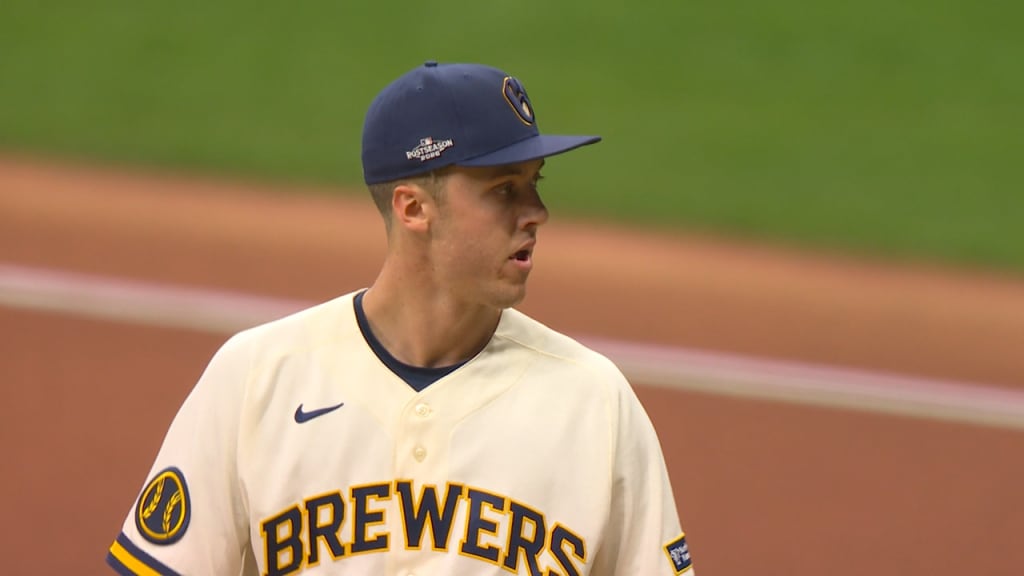
The Brewers right-hander opened Game 1 of the NLDS against the Padres by firing a 104.8 mph fastball to Fernando Tatis Jr., which MLB and Yahoo Sports identified as the fastest postseason pitch ever tracked in the Statcast era. If that number felt fake, the next one — 104.6 mph — was apparently just Misiorowski’s way of saying he had more than one setting on the remote control. For those keeping score at home, the previous postseason record belonged to Mason Miller at 104.5 mph. In other words, Milwaukee’s ace didn’t just break the record. He challenged it to a duel, then won by a clear lane.
The truly ridiculous part is that this is somehow on brand. Misiorowski already owns the record for the fastest pitch by a starting pitcher, and he kept Padres hitters in the sort of immediate emotional distress usually reserved for extra innings and bad bullpen management. San Diego did manage to make him work, foul off pitches, and scratch out a couple runs, but the larger message was impossible to miss: when this guy is locked in, the radar gun looks like it’s trying to impress somebody. The Brewers may have a lot to like in this series, but the scariest thing in October might be a 6-foot-7 starter who throws the baseball like he’s late for a connecting flight.


The Pittsburgh Pirates’ offseason did not need much more suspense. Then Ben Cherington went to Las Vegas and offered just enough clarity to make the next few weeks even more important.
Speaking during the 2026 MLB general managers meetings, Cherington said the Pirates’ front office does not feel boxed in as it tries to improve the roster. That is the encouraging part. The less exciting part is that Pittsburgh already has plenty of money committed, a large arbitration class coming due, and a decision on Brandon Lowe hanging over nearly every meaningful roster conversation.
In other words, the Pirates may have flexibility. They just do not have unlimited flexibility, which is the sort of sentence that has launched a thousand Pittsburgh offseason arguments.
Lowe is still the central question
The Pirates’ interest in bringing Lowe back remains real, and negotiations with the second baseman and his representatives are continuing. That matters because Lowe was not merely a useful addition in 2026. He became one of the most productive players on the roster and gave Pittsburgh the kind of middle-of-the-order consistency it has spent years trying to manufacture.
Lowe hit .260 with an .824 OPS, 35 home runs and 96 RBIs during his first season with the Pirates. He also played a career-high 150 games and provided meaningful defensive value at second base. Pittsburgh extended him a one-year qualifying offer worth $23.15 million, but the more significant question is whether the sides can agree on a multiyear contract before the free-agent market sets his price.

Lowe has until November 17 to accept or reject the qualifying offer. He can also continue negotiating a different deal with Pittsburgh, whether that means a shorter contract with a higher annual salary or a longer agreement designed to keep him in the lineup through the club’s emerging competitive window.
The Pirates do not have to re-sign Lowe to improve in the abstract. They do, however, have to replace his production if he leaves. That is the problem. A cheaper alternative may exist, but a cheaper alternative is not automatically an equivalent alternative. Baseball front offices sometimes treat those phrases like they are interchangeable. They are not.
The payroll has room, but the room is spoken for
Cherington’s comments about flexibility should not be interpreted as a promise of a winter spending spree. They are better understood as a rejection of the idea that Pittsburgh has already reached a hard financial ceiling.
The Pirates have approximately $57.5 million in guaranteed 2027 commitments before accounting for arbitration raises, according to offseason payroll projections. Mitch Keller is owed $18.4 million, while Bryan Reynolds, Ryan O’Hearn, Luke Weaver and Konnor Griffin also occupy meaningful portions of the club’s future payroll structure. The organization has made more substantial commitments than it did during the early rebuilding years, but those commitments now create less open space for experimentation.
Then comes arbitration. Pittsburgh has 10 arbitration-eligible players to account for, including Paul Skenes, Oneil Cruz, Jared Jones, Nick Gonzales, Spencer Horwitz and several other important young contributors. Those cases will not all produce enormous raises, but together they can transform an apparently comfortable budget into a much tighter one.
Skenes is the obvious headline name. He is entering his first arbitration-eligible season after establishing himself as the centerpiece of the Pirates’ rotation, and his projected salary is expected to rise sharply. Cruz and Jones also have strong cases for significant increases. Those are good problems to have, but they are still problems that have to be paid for.
That is why Cherington’s language matters. The Pirates may be able to add a starting pitcher, improve third base, address the bullpen or find another offensive piece. They may not be able to check every box with the most expensive option available at each position.
What Pittsburgh can realistically do
The cleanest path would be to retain Lowe and add targeted help around him. That would preserve the lineup’s most reliable source of power while allowing the front office to focus its external resources on pitching depth and defensive upgrades.
If Lowe signs elsewhere, the Pirates will have more money available, but they will also have a much larger hole. Pittsburgh could turn to the trade market, pursue a different free agent, or move Nick Gonzales back to second base and use the savings elsewhere. None of those choices would be inherently foolish. The danger would be pretending that losing Lowe has no baseball cost simply because his salary disappears from the ledger.
The same logic applies to the rest of the roster. Pittsburgh has young talent, a potentially formidable rotation core and several players entering their most important development years. The team does not need to chase splashy names for the sake of creating headlines. It needs to spend where the roster is weakest and avoid substituting quantity for quality.
That may mean one significant addition instead of three moderately expensive ones. It may mean using a trade to solve a position rather than committing long-term money in free agency. It may also mean accepting that some arbitration-eligible players will force difficult decisions before the final roster is assembled.
The Pirates’ offseason strategy is not mysterious anymore. Cherington is saying the front office can improve the team, but the path will be shaped by Lowe’s market, arbitration obligations and the money already committed to the core.
The useful takeaway is simple: Pittsburgh has enough flexibility to matter, but not enough to be careless. Keeping Lowe would preserve the biggest offensive breakthrough of 2026. Losing him would create room for other moves, but only if the Pirates spend that room intelligently. For once, the offseason question is not whether the Pirates can do something. It is whether they will do enough of the right things.
Baseball
Rays Rally: A 12-Inning Showdown That Reminded Everyone Who’s Boss
In a game that felt like it lasted longer than a family road trip with no bathroom breaks, the Tampa Bay Rays finally remembered they were supposed to be good at baseball. After watching the Milwaukee Brewers celebrate like they just won the lottery, the Rays decided it was time to show up and remind…


In a game that felt like it lasted longer than a family road trip with no bathroom breaks, the Tampa Bay Rays finally remembered they were supposed to be good at baseball. After watching the Milwaukee Brewers celebrate like they just won the lottery, the Rays decided it was time to show up and remind everyone why they were the best team in the American League. With the stakes higher than a cat on a roof, the Rays dug deep and pulled off a comeback that had fans on the edge of their seats, or maybe just on the edge of their sanity.
As the game dragged on into the wee hours, the Rays found themselves in a 3-2 hole, thanks to a home run by Brewers shortstop Cooper Pratt that had the crowd buzzing like a beehive. But instead of folding like a cheap lawn chair, the Rays rallied together, proving that teamwork makes the dream work—even if that dream involves a 12-inning marathon. Rays third baseman Junior Caminero was all about keeping the faith, saying, ‘The game’s not over until you get that 27th out.’ Wise words, Junior, wise words.
With the crowd roaring louder than a rock concert, the Rays turned the tide in the bottom of the 12th. After a fielding error by Brewers third baseman Joey Ortiz, the Rays seized the moment like a kid grabbing the last cookie from the jar. They loaded the bases and, with a pinch-hit from Ben Williamson, managed to walk it off with a 4-3 victory. It was a moment that made every fan in Tropicana Field feel like they were living in a sports movie. Now, as they prepare for Game 5, the Rays are riding high, hoping to channel their inner Rocky Balboa and keep the momentum going. Meanwhile, in other trending news, the [Brewers are still reeling from their Game 3 win](https://www.foxsports.com/stories/mlb/brewers-fans-turn-tropicana-field-milwaukee-south-after-world-series-game-3-win), and the [Red Sox are reminiscing about their historic 2004 comeback](https://www.foxsports.com/stories/mlb/eight-two-out-runs-later-brewers-one-win-away-from-first-ever-world-series-title).
Baseball
Rays Rally: How Tampa Bay Staved Off Elimination in a Thrilling Game 4 Showdown
In a game that felt more like a rollercoaster ride than a baseball match, the Tampa Bay Rays pulled off a miraculous comeback against the Milwaukee Brewers in Game 4 of the World Series. Picture this: the Rays, down 3-0 in the series and facing elimination, found themselves in the bottom of the 12th inning,…

In a game that felt more like a rollercoaster ride than a baseball match, the Tampa Bay Rays pulled off a miraculous comeback against the Milwaukee Brewers in Game 4 of the World Series. Picture this: the Rays, down 3-0 in the series and facing elimination, found themselves in the bottom of the 12th inning, staring down the barrel of a season-ending defeat. But instead of rolling over like a dog that just got its tail stepped on, they decided to fight back. With the crowd at Tropicana Field buzzing like a beehive, the Rays turned the tables on the Brewers, who had been riding high after a 10-1 victory in Game 3. It was a classic case of ‘not today, my friend!’ as the Rays strung together a series of hits that would make even the most seasoned baseball fan shed a tear of joy. And speaking of tears, did you catch the latest drama in the NFL? The trade deadline is looming, and teams are scrambling like kids in a candy store. Meanwhile, in the world of college football, the playoff picture is getting murkier than a swamp in Louisiana. But back to the diamond, where the Rays showed they still have some fight left in them. After a shaky start, they managed to capitalize on a few Brewers errors, proving that sometimes, it’s not just about how hard you hit the ball, but how well you can take advantage of your opponent’s mistakes. The game was a nail-biter, with the Rays finally sealing the deal with a walk-off hit that sent the home crowd into a frenzy. If this game was a movie, it would definitely be a blockbuster, complete with a dramatic soundtrack and a plot twist that no one saw coming. So, as we gear up for Game 5, one thing is clear: the Rays are not going down without a fight, and the Brewers better watch their backs. Who knows what will happen next? Maybe the Rays will pull off the impossible and force a Game 6, or perhaps the Brewers will remind everyone why they were the favorites in the first place. Either way, grab your popcorn, folks, because this series is far from over!

 Featured2 years ago
March Tourney: Big Money ($3 Billion!)

 Sports Gambling News2 years ago
Micah Parsons Dreams of a $40 Million Contract: The Key to His Happiness!

 General Sports News2 years ago
The Biggest World Series Favorites Since the Legendary ’02 Yankees
- Featured2 years ago
New York Jets’ Hilarious Attempt to Land Mike Vrabel Ends in Patriots’ Embrace

 Sports Gambling News2 years ago
Scottie Scheffler: The Betting Favorite at The Player

 Sports Gambling News2 years ago
Marco Penge’s Epic Comeback: From Betting Ban to Euro Tour Glory!

 NFL1 year ago
Jordan Addison’s Suspension

 General Sports News1 year ago
Trevor Lawrence Stuns Patrick Mahomes in a Monday Night Showdown